RumorGuard
For the first part of this assignment, I explored RumorGuard. RumorGuard is a resource developed by the News Literacy Project that assists individuals in identifying and assessing misinformation. It examines information using five criteria: authenticity, source, evidence, context, and reasoning. By focusing on these aspects, users are encouraged to research information further, rather than simply believing or sharing it based on its appearance.
The example I examined featured viral videos that allegedly depicted police officers in London forcefully stopping individuals riding scooters and motorcycles. RumorGuard concluded that these videos were, in fact, generated by artificial intelligence. Notably, the footage appeared highly convincing at first glance. The lesson emphasized visual discrepancies common to AI-generated content and advised viewers to examine specific details, verify coverage by reputable sources, and trace the original source of the material.
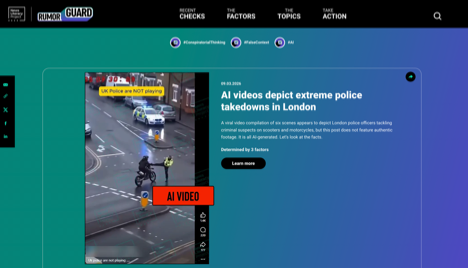
[RUMORGUARD SCREENSHOT]
RumorGuard demonstrates effectiveness by offering a methodology that extends beyond individual cases. Rather than simply stating that a specific video is inaccurate, it provides reasoning that encourages critical evaluation. The News Literacy Project assists individuals in identifying credible information and recognizing the standards inherent to fact-based journalism. However, a primary limitation is that users must still actively pause to investigate further. As many individuals rapidly scroll through social media platforms, they may not take this necessary additional step.
Fake It To Make It
For the second activity, I played Fake It To Make It.
This game addressed misinformation from a reverse perspective. Rather than identifying misleading content, my objective was to develop and disseminate information with the aim of generating revenue. The gameplay involved creating news websites, selecting stories, monitoring trending topics, and leveraging factors such as credibility and sensationalism to enhance audience engagement. Several articles were designed to elicit emotional responses, including fear and anger. Ultimately, I achieved the game’s financial target and received a completion notification.

[FAKE IT TO MAKE IT SCREENSHOT]
Experiencing the game from the creator’s view gave me insight into how misinformation spreads. It showed that chasing clicks, shares, or profits often doesn’t depend on providing correct or ethical information. Content designed to trigger strong emotions can benefit those who care most about engagement. As a result, I now see sensational headlines differently, recognizing that financial or social motives might influence what appears before me.
Studies have shown that this kind of interactive method offers significant educational benefits. A published study on game-based misinformation interventions
Studies also indicate that both game-based and graphic-based interventions can decrease the perceived credibility of misinformation, with game-based interventions demonstrating a more pronounced impact. Additionally, research on psychological inoculation suggests that prior exposure to misinformation techniques can enhance individuals’ ability to identify subsequent attempts at manipulation.
Overall, both tools proved valuable for distinct purposes. RumorGuard encouraged a more deliberate approach to evaluating information, while Fake It To Make It provided insight into the creation and dissemination of misleading content. Educational games are particularly effective as they foster active engagement rather than relying solely on passive reading about misinformation. However, it is important to note that no game can fully eradicate misinformation. These resources are most effective when users apply the critical thinking skills acquired to their daily interactions with information.